Forex for beginners in 2026
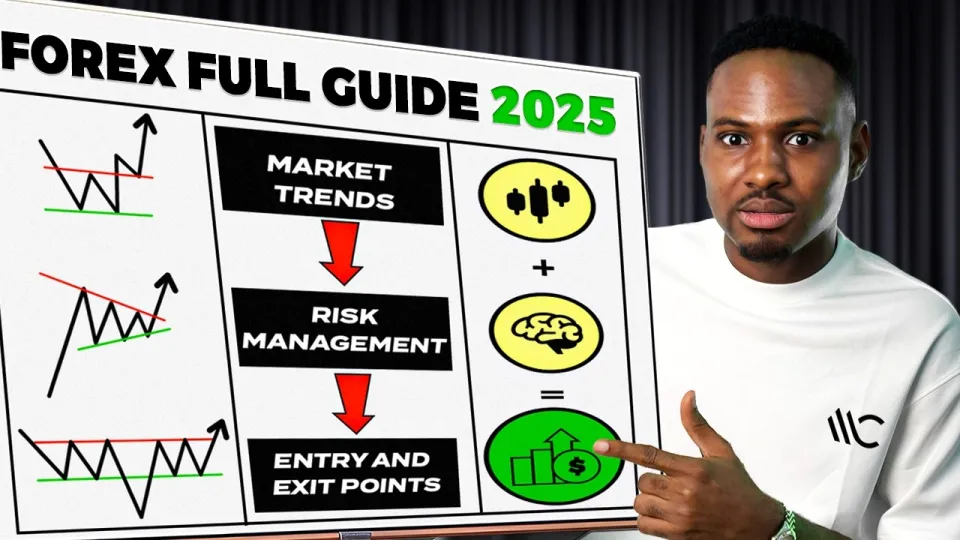
Video: How To Start Forex Trading For Beginners’ 2025 (Full Course)
You can order the same kind of articles for your own video to boost it on YouTube and Google. Just message the Telegram bot @sat_sit_bot. The bot writes and publishes the articles itself (with your YouTube video embedded) on popular topical websites (no ads). Try it free: 50 articles on us.
· based on the channel Jeffrey Benson Forex
Key takeaways
- Forex is an over-the-counter market where currencies trade in pairs 24 hours a day, five days a week, across sessions in Sydney, Tokyo, London and New York.
- A beginner needs four things before risking money: a broker, a platform such as MetaTrader 5, a written strategy and a risk rule that caps loss per trade.
- Demo trading first is standard practice; it lets you test order types, spreads and session behaviour without capital at risk.
- Risk management, not signal-following, is the skill most beginners report struggling with longest.
- Jeffrey Benson Forex runs a free full-length beginner course and a student program at firepipsfx.com/plans.
Forex for beginners works best as a structured course rather than a pile of random clips: you learn what the currency market is, how sessions and leverage work, which tools you actually need, and only then place a first trade on a demo account. A single well-ordered curriculum removes the guesswork that makes beginners quit, and the free full course published by Jeffrey Benson Forex is built exactly that way — with a paid student track available at the Fire Pips FX plans page for those who want structured follow-up.
What forex trading actually is and why beginners get confused
Forex is the market where national currencies are exchanged in pairs, and every price you see is the value of one currency measured in another. When you buy EUR/USD you are simultaneously buying euros and selling dollars; the quote tells you how many dollars one euro costs. There is no central exchange — trading happens over the counter through a network of banks, brokers and liquidity providers, which is why spreads and execution quality differ from broker to broker.
Three structural facts shape everything a beginner does:
- It runs around the clock on weekdays. The market opens in Sydney, rolls into Tokyo, then London, then New York. Liquidity and volatility peak when London and New York overlap.
- Leverage is built in. A broker may let you control a position many times larger than your deposit. That magnifies both gains and losses, and it is the single fastest way for a new account to disappear.
- Most retail volume is speculative. You are not settling international invoices; you are taking a view on price direction, and you pay the spread on every entry and exit.
Understanding that a currency pair is a relative bet, not an asset you own, is the mental shift that separates a trader from a gambler.
How the market moves through the four sessions
Session timing explains most of the day-to-day behaviour beginners find baffling. The Sydney session is thin and range-bound; Tokyo brings yen and Australian dollar activity; London delivers the largest volume and the cleanest trends; New York adds US data releases and often reverses the London move. A pair like GBP/USD is far more active during London hours than at 3 a.m. European time, and trading it outside its active window usually means wider spreads and choppier price.
A practical approach is to pick one session, one or two pairs, and one hour of the day, then study that window until its rhythms become familiar. Beginners who jump between pairs and time zones rarely build pattern recognition.
Tools and setup you need before the first trade
You need a broker account, a trading platform, a charting routine and a journal — nothing more, regardless of what shopping lists of indicators suggest.
- A regulated broker. Check which regulator supervises the entity you are signing with, what leverage it permits for retail clients, and how deposits and withdrawals are processed. Demo accounts are free and should be your first stop.
- A platform. MetaTrader 5 (MT5) is the most common choice: it handles charting, order types and one-click execution, and most brokers supply it. Linking your broker account to MT5 is a short setup step.
- A charting routine. Two or three timeframes are enough — a higher one for direction, a lower one for entries. Cluttering a chart with a dozen indicators hides price, which is the only thing that pays.
- A trade journal. Record the pair, session, reason for entry, stop placement, result and emotion. Reviewing twenty logged trades teaches more than twenty more videos.
A demo account is not a formality. It is where you learn how stop-loss and take-profit orders behave, how spreads widen around news, and how slippage feels — with zero capital at risk.
Building a simple strategy foundation
A strategy is a written set of conditions that tells you when to enter, where to place your stop, where to take profit, and how much to risk — decided before the chart is open. Beginners do best with a small number of building blocks: support and resistance or recent highs and lows for levels, a trend filter such as a moving average for direction, and a candlestick pattern or a break of structure for the trigger.
The test of a strategy is not whether it looks clever but whether you can execute it identically fifty times. Write the rules in plain language, backtest them on historical charts, then forward-test on demo. If the rules require discretion you cannot articulate, they are not rules yet.
Placing a first trade and sizing it correctly
Placing an order means choosing direction, entry, stop-loss, take-profit and position size — and size is where beginners lose money they did not intend to risk. A workable rule: risk a fixed small percentage of the account per trade, commonly 1%, and derive the lot size from the distance between entry and stop. If the stop is 30 pips away and you may lose $10, the position size follows from that arithmetic, not from how confident you feel.
A typical first sequence looks like this: identify the higher-timeframe direction, wait for price to reach a level you marked in advance, enter on your trigger, place the stop beyond the level that would prove you wrong, set a target at least as large as the risk, and log the trade. Then leave it alone.
Mistakes beginners repeat and how to avoid them
Most blown beginner accounts fail for the same handful of reasons, and each has a straightforward countermeasure. Overleveraging tops the list: using maximum available leverage turns a normal losing streak into a wiped account, so cap risk per trade and per day. Revenge trading — re-entering immediately after a loss to win it back — is the second classic; a daily loss limit stops it mechanically. Overtrading in quiet sessions, moving stop-losses to avoid taking a loss, and following signal channels without understanding the setup all stem from the same root: no written plan. Finally, beginners routinely skip the journal, which means they cannot tell whether a loss came from a bad strategy or bad execution.
Common beginner questions answered
Many newcomers ask how long it takes before trading becomes consistent. The honest answer is months of deliberate practice, not weeks; the traders who progress fastest are the ones who treat demo results as data rather than as a scoreboard. Others worry they are not "mathematical enough" — but the arithmetic involved is position sizing and percentages, and writing notes during study is what makes session times and rules stick. A frequent doubt is whether free education can be as good as paid courses; a well-structured free course covers the same foundations, and what paid programs add is usually accountability and feedback. And the most common question of all — whether copying someone else's trades is a shortcut — deserves caution: copying can show you how a professional manages entries and exits, but it does not transfer the risk discipline that keeps an account alive.
Useful links
- Student plans and course access: https://firepipsfx.com/plans
- Free daily signal channel: https://t.me/firepipsignals
- Broker registration referenced in the course: https://my.assexmarkets.com/auth/register?partner_code=1699134
- Premium signal group access: https://t.me/jeffreybenzhelpbot
Bottom line
Forex rewards preparation far more than enthusiasm, and the fastest route from curiosity to competence is a single structured course you finish rather than a hundred clips you skim. Learn what the market is, respect session timing, set up a broker and MT5, write your rules down, size every trade from your stop, and keep a journal from day one. The free full course from the Jeffrey Benson Forex channel covers exactly this ground in one sitting, which makes it a sensible starting point before you consider paid mentorship. When you are ready for structured follow-up, the student plans are listed at firepipsfx.com/plans.
Questions & answers
How much money do I need to start forex trading?
You can open many accounts with a small deposit, but the amount matters less than the risk per trade. If you risk 1% per trade, a $200 account risks $2 per position, which is workable for learning but too small to generate meaningful income. Start on demo, then fund only what you can afford to lose entirely.
Is it better to learn forex from a full course or from short videos?
A full course gives you an order: market structure, sessions, tools, strategy, execution, risk. Short videos are useful later for specific questions, but as a primary source they leave gaps — usually in risk management, which is the part that decides whether an account survives.
Can I copy another trader's signals instead of learning?
Copying shows you how a professional times entries and exits, and it can be a useful supplement. It does not transfer the discipline of sizing positions and cutting losses, so traders who only copy often fail when a signal goes wrong or when they start improvising on their own.
How long before I can trade consistently?
Expect several months of deliberate practice: backtesting rules, then forward-testing on demo, then a small live account. Consistency comes from executing the same written plan repeatedly, not from finding a better indicator, so measure progress by rule adherence rather than by profit.
Source: How To Start Forex Trading For Beginners’ 2025 (Full Course) · Markdown version